
1.INTRO
2.EMPERICAL POETIC
READING ALOUD Reading a poem silently ( as compared to aloud)is the difference between staring at sheet music and playing the music on an instrument.Recitation equates poetry to the experience of viewing a painting or touching a sculpture...each time the viewer / reciter brings a uniqueness of the moment to the 'happening' & thus the experience can differ each time . ..a byproduct of reading aloud can also be a useful learning /editing technique to use before finalising/publishing[posting] the poem
POETRY A VISUAL FORM
Poetry as a  written artform naturally has a visual aspect thereto.We read with our eyes so line length&line breaks become key limiting factors to both our enjoyment&ease
understanding.Fomat helping to distingush&separate poetry as an artform in its purest sense from the rival written art of prose&thereby puts poetry closer to art than literature.
CADENCE&PUNCTUATION to punctuate or not that is the radical question  we poets must decide as we pick up our stylus&follow traditions .As Black Mountain poet Olson put it.. can syntax be shaped by sound.
Cadence is a poetic 'must have'  for our art & traditions of capitalisation (&emphasis inherent therein) too often can be ' a technique too far' inhibiting expression & visually stilting the reading flow..e e cumings lower case poetry style showed valid alternative poetics .The 'one breath length' limitation being intuitive is perhaps a better cadence in any event .
Admittedly grammar&punctuation are exercises to learn&understand before omitting&as such are a proven  flexiblity  to enhance our poetic art that can vary understanding ,&if omitted be safely left to the reader
PROCESS The 'process' (itch to write),as with art forms like gestural abstracts action painting,so often is more significant than the content...a process within that desires satisfaction ...with enunciation .."the medium (that) is the message The poetics emerge organically as blossom from inspiration & embrace a natural placement to visually evolve into verse in a harmonious dance twixt content & form unfurling as a flower in an the emotional landscape of symbioticthought becominga tapestry of perceivable wordplay indentation spacing &line breaks in woven cadences of expressive effect
MODERN POETRY HISTORY a creative- written & verbal art evolves naturally as the past century has revealed commencing with the Imagists in the early 1900's who 'freed up' traditional poetic thinking, along with the English  language  translators of Japanese haiku forms who thereby stimulated the interest & innovations in English short form poetics.
Recited rhymes,commonly known by all, was stimulated into wider-spread interest  in  all poetry  by the invention of the  typewriter,soon  followed by digital devices linked to the internet faciltated the process whereby poetry became a common art practised daily  by  thousands worldwide.The result being sites like PS in the early 21st century which continued & widened the evolution of poetry.
hence my style
OPEN VERSE using spaces&breaks/no grammatical symbols /relying on 'the one breath limitation'/thus intuitive cadence permits the 'reader' (reciter)to respond in an interpretative-interplay unique** to the ' happening moment'
numbers
man
persistent
& realistic
witha loveof red-ballcricket
naturallyspontaneoussocreativeas anartist
rhymerofopen* poetryforone
& all to see
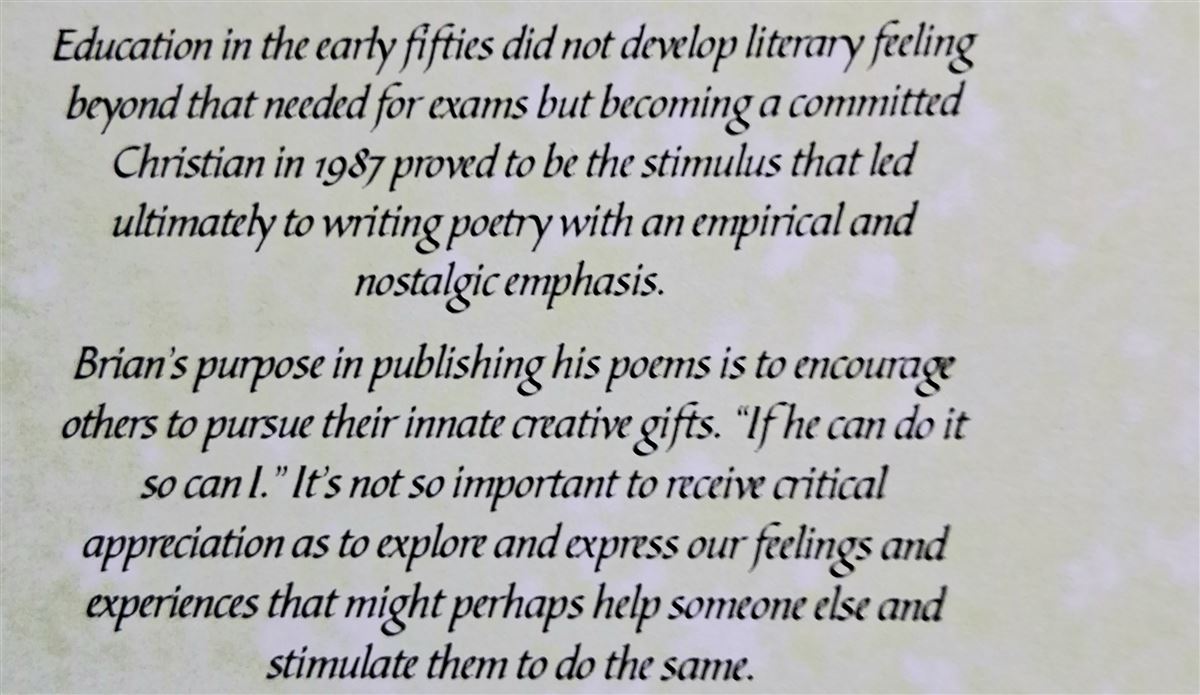
English imagist& experimental poet in open **(see below)verse&creator of the footle & emagi shape forms,editor of Flowers of Life(the Cinquains of William Soutar);and author of Poiema (isbn 1902203562)a selection of Ekphrasis. Hear my recitations &view my artwork on youtube under both my name Brian Strand & under my pen name ichthyschiro.Read my poetry@strandpoet on X(twitter
checkout poetry examples @

